


 (32) 232 19 65

Container trailers and box lorries
Container trailers
are a practical solution for businesses and private users who need to transport goods, tools, equipment or fittings safely. The enclosed design protects the cargo being transported from rain, snow, dust and unauthorised access. Our range includes container trailers in various sizes, gross vehicle weights and equipment configurations. Both lightweight models up to 750 kg and larger braked trailers designed for more demanding applications are available. Box vans and body-built trailers are ideal for transporting, amongst other things, tools, machinery, motorbikes, event equipment, commercial fittings and materials used by construction and maintenance teams. Depending on the model, the trailer can be fitted with side doors, rear doors, a tail lift, additional security features, interior lighting, transport handles or bespoke fittings. Every WIOLA body-fitted trailer is built using durable materials and robust components. The stable chassis, sturdy container structure and the ability to customise the fittings allow you to choose a model suited to your specific business needs. View the available container trailers, compare their dimensions and fittings, and then choose the van best suited to your transport needs.


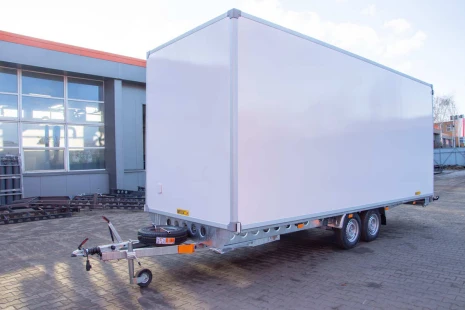
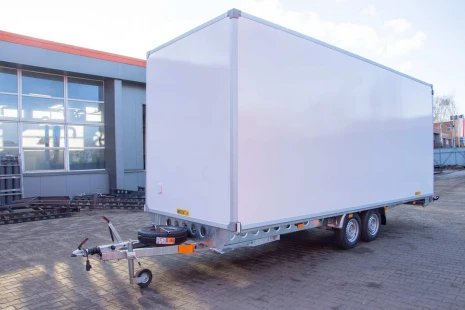
Container trailers – safe transport in an enclosed body
A container trailer combines the mobility of a standard car trailer with the functionality of an enclosed transport space. The rigid body protects the items being transported from adverse weather conditions, dirt and unauthorised access.
Container trailers, also known as box trailers, enclosed trailers or cargo trailers, are suitable for both business and private use. They can be used to transport construction equipment, tools, service equipment, appliances, furniture, motorbikes, bicycles, advertising materials and goods intended for sale.
The enclosed space also makes it easy to leave equipment securely stored in the trailer between jobs. This means that a container trailer can serve as a mobile warehouse, technical base or workshop.
Container trailers and box trailers – different terms, similar uses
Customers looking for an enclosed trailer use a variety of terms. The most common are:
- container trailers,
- container trailers,
- van trailers,
- van-type trailer,
- container van,
- cargo van trailer,
- box van trailer,
- enclosed trailer,
- enclosed trailer,
- container trailer.
All these terms refer to trailers with a rigid, enclosed load compartment. Depending on the model, it may be fitted with double rear doors, side doors, a tail lift, lighting, transport handles or a bespoke interior fit-out.
A container van trailer can be used for regular work, occasional transport or as a mobile base for a business. The right configuration allows it to be tailored to a specific industry and the type of equipment being transported.
750 kg container trailer – a lightweight van for Category B
For users looking for a compact solution, the 750 kg container trailer is available. Its lightweight design is ideal for transporting tools, garden equipment, company equipment, smaller appliances and goods requiring protection from the elements.
A lightweight container trailer can be a good choice for an installation, maintenance, renovation or retail business. Its compact dimensions make it easy to manoeuvre, park and store. However, before purchasing, you should check the actual load capacity of the specific model, as the trailer’s kerb weight and that of any additional equipment must be deducted from the maximum authorised mass (MAM).
A lightweight container trailer can also serve as a mobile storage unit. It allows you to organise the items being transported and reduces the need to constantly transfer tools and materials to the car.
Wiola’s range includes lightweight models from the Cargo series, with a maximum authorised mass of up to 750 kg. Larger container trailers with a higher load capacity are also available, designed for heavier and more demanding applications.
Container trailers for business and private use
A container trailer can be used by businesses across a wide range of sectors. It is particularly well-suited to companies in the following sectors, amongst others:
- construction and renovation,
- plumbing and electrical firms,
- maintenance,
- event organisations,
- retail,
- catering,
- automotive,
- courier and delivery,
- gardening,
- sports and leisure.
For construction teams, the trailer can serve as a mobile store for power tools, cables, assembly materials and measuring equipment. Event companies can use it to transport sound systems, lighting, tents, furniture and stage props.
Private users can use the trailer to transport a motorbike, bicycles, camping gear, household items or objects that need protection from rain and dirt.
Regardless of whether a user types ‘container trailer’, ‘trailer container’ or ‘container trailer’ into a search engine, the most important thing is to ensure that the dimensions and load capacity are suitable for the intended use.
The box trailer as a mobile warehouse
A box trailer can serve as a mobile storage unit transported directly to the job site. This is a practical solution for businesses that operate in various locations and require constant access to tools, spare parts and materials.
Once the interior has been fitted with shelves, transport rails, partitions and handles, a box trailer can be used as:
- a mobile workshop,
- a tool store,
- a service trailer,
- support vehicle for sporting events,
- a trailer for a technical crew,
- event equipment store,
- exhibition trailer,
- retail facilities.
This solution helps to organise the equipment and protects it during transport. It also reduces the time needed for loading and unloading before each job.
Cargo van trailer for transporting tools and equipment
The cargo van trailer is primarily designed for transporting items that require protection and security. Its enclosed design is ideal for transporting power tools, machinery, technical equipment, transport crates and commercial equipment.
Compared to a standard open-sided trailer, the box trailer provides better protection for the items being transported against rain, mud, dust and direct sunlight. There is also no need to put the tarpaulin on and take it off every time.
The smooth walls of the bodywork can be used as an advertising space. Branding with a logo, website address and telephone number means that the box trailer can simultaneously transport equipment and promote the company whilst on the move and when parked.
Box van trailer with doors or a ramp
The term ‘box van trailer’ is used to refer to enclosed trailers with a box-type body. The method of access to the interior should be chosen according to the type of load being transported.
Double rear doors are ideal for transporting parcels, tools, equipment and goods loaded by hand. A tailgate or loading ramp, on the other hand, makes it easier to load wheeled equipment, motorbikes, trolleys, transport crates and heavier equipment into the trailer.
Additional side doors can provide quick access to the front of the load compartment. This is particularly useful in trailers used as mobile workshops or service vehicles.
Single-axle or twin-axle container trailer?
The choice of the number of axles should depend on the trailer’s dimensions, the weight of the equipment being transported and the frequency of use.
A single-axle container trailer is compact and easy to manoeuvre. It can be a good solution for transporting lighter equipment, tools, materials and commercial goods.
Twin-axle models usually offer more load space and can be used for heavier applications. The two axles help to distribute the load and ensure stable handling of the trailer, provided it is loaded correctly.
Before choosing a specific model, it is worth comparing:
- the internal dimensions of the body,
- kerb weight,
- actual payload,
- the maximum authorised mass,
- the number of axles,
- type of braking system,
- height of the load compartment,\
- type of door or ramp,
- the towing capacity of the towing vehicle.
Equipment for container trailers
A trailer’s functionality depends not only on its dimensions, but also on the appropriate equipment. Depending on the model chosen and its intended use, the trailer may feature:
- load securing points,
- handles for transport straps,
- transport rails on the walls,
- adjustable partitions,
- side doors,
- double-leaf rear doors,
- a ramp or tail lift,
- load compartment lighting,
- stabilising supports,
- a support wheel,
- additional door and coupling locks,
- shelves or bespoke fittings.
Carefully selected brackets and rails help to secure the load and prevent it from shifting during acceleration, braking and cornering.
Bespoke container trailer
The standard model does not always meet the specific requirements of your business. Therefore, the trailer can be configured in accordance with the user’s individual requirements and technical capabilities.
Customisation options include, amongst others, the body dimensions, gross vehicle weight, number of axles, type of rear closure, door layout, fixing points and interior fittings.
A bespoke configuration is particularly useful when the box trailer is to be used as a mobile workshop, service trailer, technical support unit, event trailer or specialised transport container.
How to choose a container trailer?
You should start by determining the dimensions and weight of the cargo you will be transporting most frequently. You also need to consider the loading method, the necessary security measures and the frequency of use.
A 750 kg box trailer may be sufficient for transporting light equipment. For larger devices, heavy machinery or a large quantity of equipment, a larger braked trailer will be a better option.
It is worth allowing for an adequate load capacity reserve. The weight of the equipment being transported should include shelves, partitions, handles, a spare wheel and other additional fittings.
Wiola container trailers – choose the right model
Wiola’s range includes lightweight and braked container trailers, designed for a variety of applications. Individual models differ in length, width, height, number of axles and maximum authorised mass.
You can choose from both a compact, lightweight container trailer and a larger container van designed for the regular transport of heavier equipment. Take a look at the models in the Cargo series, compare their specifications and choose the trailer that best suits your business’s needs.
FAQ – container and box trailers
What is a container trailer?
It is a car trailer with a rigid, enclosed body that protects the items being transported from the weather, dirt and unauthorised access.
Do ‘van trailer’ and ‘container trailer’ mean the same thing?
These terms are often used interchangeably. Both box trailers and container trailers have an enclosed load compartment. However, individual models may differ in terms of materials, dimensions, fittings and intended use.
Is a 750 kg container trailer available?
Yes, our range includes lightweight container trailers with a maximum authorised mass (MAM) of up to 750 kg. Before making a choice, you should check the unladen weight and actual load capacity of the specific model.
What is a container trailer used for?
It can be used to transport tools, equipment, commercial goods, motorbikes, bicycles, event equipment and other items requiring protection from the weather.
Can a van-type trailer have a loading ramp?
Depending on the model, the trailer can be fitted with a ramp or a tailgate, which makes it easier to load motorbikes, trolleys and wheeled equipment.
Can a box trailer be made to order?
The scope of customisation depends on the model and technical capabilities. It may be possible to tailor the dimensions, doors, ramp, transport brackets and interior fittings.