


 (32) 232 19 65

Cable trailers
Wiola cable trailers are specialist cable trailers designed for the transport and unwinding of cables from reels. They offer a practical solution for companies carrying out power installations, telecommunications networks, connections, earthworks, construction works and infrastructure projects.
A cable trailer facilitates the transport of a cable reel and allows it to be conveniently unwound directly at the work site. Thanks to its specially designed structure, it ensures stable transport of the cable reel and efficient handling during installation. Trailers of this type are particularly useful where safety, ease of loading and the rapid unrolling of cables in the field are key considerations.
The cable trailer range includes models designed for various applications, from lighter installation work to the more demanding transport of larger cable reels. Wiola cable trailers can be used by energy companies, construction firms, installation teams, fitters and cable network contractors.
If you are looking for a cable trailer, cable trailer or cable-unreeling trailer, choose a model suited to the drum’s diameter, width, weight and operating conditions. Their robust construction, braked axles and suitability for use with cable reels make Wiola trailers a good choice for everyday business use.


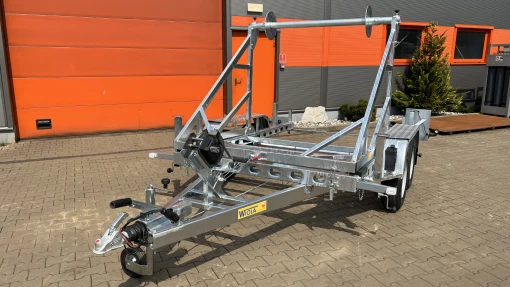

Cable trailers for transporting and unrolling cables
Cable trailers are designed for the transport of reels containing wires, power cables, telecommunications cables and fibre-optic cables. Their carefully engineered design allows the drum to be transported safely to the installation site, and the cable on it to be unrolled with ease.
A cable reel trailer streamlines the work of installation teams, reduces the need for additional transport equipment and helps to organise the unwinding of cables. This solution is used both during the construction of new networks and the modernisation of existing infrastructure.
WIOLA offers cable trailers with a range of permissible gross vehicle weights. This means you can choose a model suitable for both lighter reels used in local installations and heavier spools used in larger energy and telecommunications projects.
What is a cable trailer used for?
The primary function of a cable trailer is to transport a cable drum between the warehouse, the company’s base and the work site. The trailer’s design also allows cables to be unwound without the need to remove the entire drum first.
Cable trailers can be used during:
- the construction and modernisation of power networks,
- the installation of electrical connections,
- laying underground cables,
- the construction of telecommunications networks,
- the installation of fibre-optic cables,
- road and infrastructure works,
- maintenance of industrial networks,
- carrying out installation work on construction sites.
A cable transport trailer is particularly useful where the drum needs to be moved frequently and the cable unwound directly whilst excavating or carrying out installation work.
Trailer for cable reels
Cable reels can vary significantly in weight, diameter and width. For this reason, a cable reel trailer should be selected to suit the specific parameters of the load being transported.
Before selecting a model, check:
- the weight of the drum together with the wound cable,
- the maximum diameter of the drum,
- the drum’s width,
- the diameter of the shaft hole,
- the required maximum authorised mass (MAM) of the trailer,
- permissible trailer weight for the vehicle,
- method of loading and unloading,
- the terrain over which the combination will be travelling.
Choosing the right trailer not only affects the ease of operation, but also the stability of the load and the correct weight distribution.
Single-axle cable trailer
A single-axle cable trailer can be a good solution for transporting lighter reels and for work carried out in confined spaces. Its smaller dimensions make it easier to manoeuvre on building sites, access roads and development sites.
WIOLA’s range includes single-axle cable trailers with a maximum authorised mass (MAM) suited to various types of reels. Individual models can be selected to match the weight of the cable being transported and the towing capacity of the towing vehicle.
A single-axle cable trailer, also commonly known as a ‘cable trailer’, is ideal for, amongst others, electrical installation, telecommunications and maintenance companies that transport reels over shorter distances or carry out local jobs.
Twin-axle cable trailer
A twin-axle cable trailer is designed for transporting larger and heavier reels. The two axles allow the load weight to be distributed more evenly and ensure stable support for the structure whilst travelling and carrying out work.
Two-axle models are primarily chosen by companies undertaking major energy, industrial, construction and telecommunications projects. They can be used to transport heavy reels containing power cables, installation cables or pipes intended for infrastructure construction.
The range includes cable trailers with a maximum authorised mass (MAM) of 2,700, 3,000 and 3,500 kg. However, before selecting a specific model, the actual weight of the drum and the trailer’s unladen weight must be verified.
3,500 kg cable trailer
The 3,500 kg cable trailer is designed for the professional transport of heavy cable reels. This model is ideal for the development of extensive power networks, the construction of industrial infrastructure and installations requiring the transport of large quantities of cable.
Please note that a gross vehicle weight rating (GVWR) of 3,500 kg does not equate to a payload of 3,500 kg. The gross vehicle weight rating includes the trailer’s unladen weight and the weight of the cable drum it is carrying. The actual load capacity should therefore always be checked in the technical specifications of the selected model.
The towing vehicle must be capable of towing a trailer of a specified weight. The maximum authorised mass of the entire combination and the driver’s driving licence category must also be taken into account.
Trailer for unrolling cables directly on site
A cable-unreeling trailer allows the cable to be fed directly from the mounted drum. This means there is no need to remove the heavy reel and place it on a separate stand.
Before starting to unroll the cable, stabilise the trailer, check the position of the drum and ensure that the safety devices have been fitted correctly. The cable should be unwound evenly, without sudden jerks or uncontrolled rotation of the drum.
This solution allows for more efficient organisation of work along trenches, roads, railway tracks, industrial halls and other sites where long sections of cable are being laid.
Trailers for power cables and fibre-optic cables
Cable trailers can be used to transport various types of cables. They are used not only in the power sector, but also in telecommunications and during the construction of fibre-optic networks.
A fibre-optic cable trailer facilitates the transport of pipes, microtubes and cables wound onto reels. In this case, it is particularly important to ensure the material is unwound smoothly and to minimise the risk of it becoming kinked or damaged.
When choosing a trailer, you should take into account the specifications of the specific reel, rather than just the type of cable it carries.
How do you choose a trailer for transporting cable?
The most important parameter is the maximum permissible gross weight. This should be tailored to the trailer’s unladen weight and the maximum weight of the reel being transported. It is advisable to allow for a suitable margin so as not to exceed the permissible limits during day-to-day operations.
The number of axles, the size of the space allocated for the drum and the method of securing it are also important. In the case of frequent journeys over uneven terrain, the stability of the structure and adequate protection of the drum against movement are particularly important.
When making your choice, it is worth comparing:
- the gross vehicle weight range,
- kerb weight and payload,
- the number of axles,
- the maximum drum diameter,
- the maximum drum width,
- loading method,
- equipment to facilitate cable unwinding,
- the option to fit additional components.
WIOLA cable trailers
WIOLA offers single-axle and twin-axle cable trailers with a gross vehicle weight (GVW) ranging from 750 to 3,500 kg. The available variants allow you to select a trailer suited to the drum’s weight, the type of work to be carried out and the specifications of the towing vehicle.
Cable transport trailers are designed for energy companies, electrical installation firms, telecoms network operators, fibre-optic contractors, industrial plants and companies carrying out infrastructure projects.
Take a look at the available models and compare their maximum authorised mass (MAM), number of axles and technical specifications. If you need help making a choice, please contact the WIOLA sales department. An advisor will help you select a cable trailer suitable for the size and weight of the reels you use.
Frequently asked questions
How do I choose a trailer for a cable drum?
You should check the weight, diameter and width of the drum, and then compare these with the load capacity and permissible dimensions for the specific trailer.
Can cable be unwound directly from a cable trailer?
Yes, cable trailers are designed not only to transport the cable but also to allow it to be unwound from the mounted drum at the work site.
Single or twin-axle – which cable trailer should you choose?
A single-axle model is suitable for lighter reels and in locations requiring easier manoeuvring. For heavier reels, it is worth considering a twin-axle trailer with a correspondingly higher gross vehicle weight rating (GVWR).
Is a cable trailer suitable for transporting fibre-optic cables?
Yes. It can be used to transport reels of fibre-optic cables, telecommunications cables, pipes and micro-tubes, provided it is correctly matched to the reel’s specifications.
Does a GVW of 3,500 kg mean a payload of 3,500 kg?
No. The maximum authorised mass (MAM) includes the combined mass of the trailer and the reel being transported. The payload is the difference between the MAM and the unladen mass of the specific model.