


 (32) 232 19 65

For transporting construction equipment
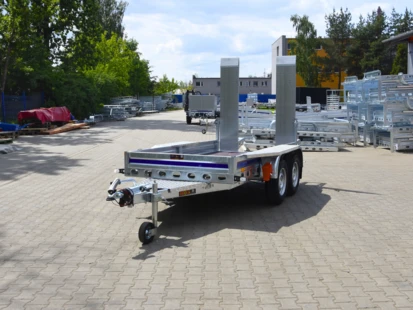
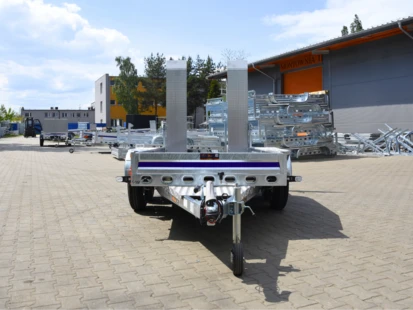
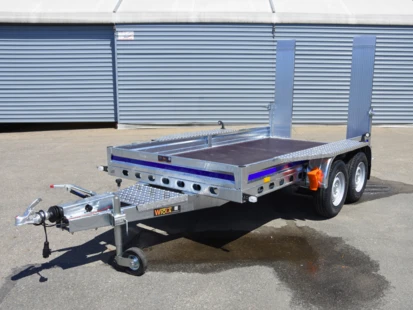
Wiola mini-excavator trailers are robust and functional models designed for the transport of construction machinery, work equipment and heavier technical loads. They are ideal for the day-to-day operations of construction, paving and installation firms, equipment hire companies, and users who need a safe way to transport mini-excavators. This category features braked trailers for transporting mini-excavators, designed with stability, durability and convenient loading in mind. A suitably selected design, ramps or steps, stabilising supports and load-securing brackets help to safely prepare the machine for transport. A mini-excavator trailer should be suited to the weight, width and length of the machine being transported. That is why our range includes various models of construction trailers, allowing you to choose the right one for your specific application – from transporting a compact mini-excavator to transporting other machinery and work equipment. Wiola mini-excavator trailers are characterised by a durable frame, a braked design and practical features that make working on site easier. This is a good solution for those looking for a sturdy trailer for transporting a mini-excavator, ready for intensive use on construction sites and for company transport.
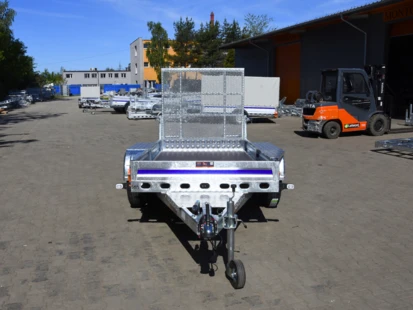
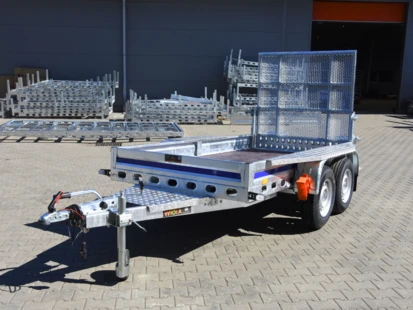
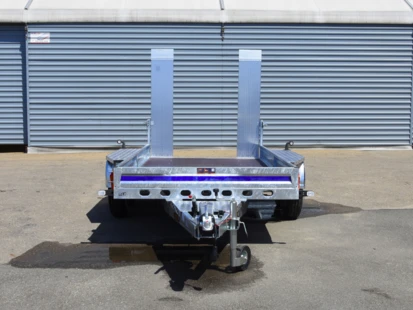
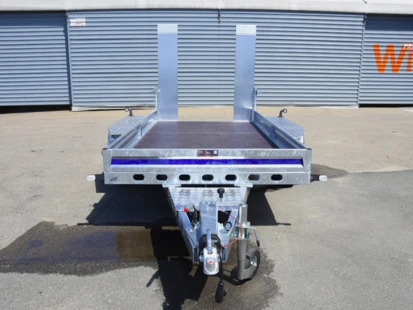
Trailers for transporting construction equipment
Transporting a mini-excavator, road roller, lift or compactor requires the use of a trailer designed to handle heavy loads. A standard goods trailer may not have the appropriate load capacity, floor construction, securing points or a system to allow a heavy machine to be loaded safely.
A trailer for transporting construction equipment should be suited to the weight, width, length and wheelbase or track width of the machinery being transported. The position of the centre of gravity, the method of securing the load and the ability to position the machine correctly in relation to the trailer’s axle are also important.
Wiola models can be used to transport:
- mini-excavators and small excavators,
- road rollers,
- soil compactors,
- scissor lifts,
- mobile platforms and aerial work platforms,
- garden tractors,
- ride-on mowers,
- compact loaders,
- skid steer loaders,
- paving equipment,
- generators and compressors,
- municipal equipment,
- machinery used in horticulture and forestry.
Mini-excavator trailer
A mini-excavator trailer is one of the most popular types of construction trailer. It allows the machine to be transported directly to the building site, the customer’s premises or the location where earthworks are to be carried out.
Mini-excavators are compact, but their weight can range from several hundred kilograms to several tonnes. For this reason, before purchasing a trailer, you should check not only the maximum authorised mass (MAM) but, above all, its actual load capacity.
The payload is calculated by subtracting the trailer’s unladen weight from its gross vehicle weight. The following must also be added to the weight of the excavator being transported:
- buckets and additional attachments,
- a hydraulic hammer,
- a drilling rig,
- a quick-coupler,
- fuel in the tank,
- tools and equipment carried on the trailer.
A well-chosen trailer for a mini-excavator should provide a margin of load capacity. You should not choose a model whose maximum specifications are almost identical to the weight of the combination being transported.
Trailers for mini-excavators and excavators
Customers often search for this type of product under the names ‘mini-excavator trailer’ or ‘excavator trailer’. Unlike a typical car transporter, a construction trailer may feature side panels, a bucket support, a reinforced ramp and a floor designed to withstand the point loads caused by wheels or tracks.
The bucket support allows the excavator’s boom and attachments to be positioned correctly during transport. It also helps to make the most of the load space and to position the machine in a way that ensures the correct pressure on the coupling.
Before setting off, the boom, bucket and any other attachments must be lowered and secured to prevent movement. The machine itself should be secured using suitably selected transport chains or straps.
Construction machinery trailer
A trailer for construction machinery can be used for much more than just transporting excavators. Its appropriate dimensions and load capacity allow it to carry many types of equipment used by construction, roadworks, paving, installation and gardening companies.
Depending on the job at hand, a single trailer can transport a mini-excavator, a road roller, a compactor, a telehandler or a skid-steer loader. This is advantageous for companies that own several machines and require a versatile means of transport.
Before loading any machine, you must check:
- its actual operating weight,
- its dimensions with attachments fitted,
- the wheel or track track width,
- the height and width of the trailer,
- the load-bearing capacity of the access roads or ramps,
- the permissible floor load,
- layout of lashing points.
Trailer for transporting rollers and compactors
A trailer for transporting road rollers should have a floor capable of withstanding high localised loads and a sufficiently wide loading ramp. This applies in particular to guided and self-propelled rollers, whose weight is concentrated over a small area.
Similar requirements apply to trailers used to transport compactors, rammers and paving equipment. These machines should be secured to prevent them from sliding or overturning during braking and when negotiating bends.
Smaller items of equipment may be transported alongside a mini-excavator, but only if the platform dimensions, the trailer’s load capacity and the correct load distribution allow for this.
Trailer for transporting aerial work platforms and lifts
A trailer for transporting aerial work platforms can be used to carry scissor lifts, mast lifts and other compact equipment designed for working at height. In this case, the machine’s weight, width and ground clearance are particularly important.
Some aerial work platforms have low ground clearance and a long wheelbase. Before choosing a trailer, you should therefore check the approach angle and the transition between the ramp and the floor. An entrance that is too steep may cause the machine’s chassis to rest against the edge of the platform.
For heavier machines, a wide, full-width access ramp may be advantageous, as it allows for easy access regardless of the wheelbase.
Access ramps or a full loading ramp?
There are two basic methods of loading used in trailers for construction machinery: separate access ramps and a full ramp.
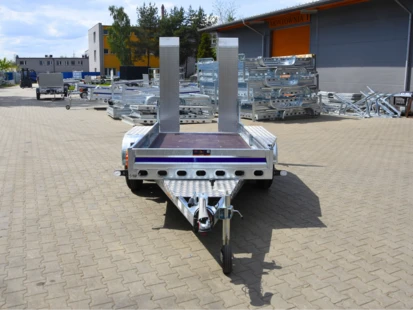
Trailer with separate access ramps
Separate access ramps can be positioned to match the width of the machine’s wheels or tracks. Once loading is complete, they are secured in the designated transport position.
This solution can reduce the trailer’s unladen weight and offers great flexibility when transporting machinery with different wheelbases.
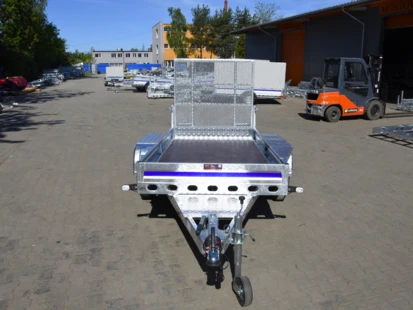
Trailer with an entry ramp
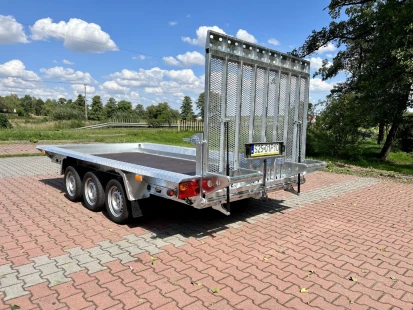
The full-width ramp creates a wide access area. It facilitates the loading of machinery with different wheelbases, as well as smaller equipment that would be difficult to position on two separate ramps.
The cylinder-assisted ramp is easier to raise and lower. Integrated rear supports stabilise the trailer whilst a heavy machine is being driven onto it and prevent the drawbar from lifting or the towing vehicle from being overloaded.
Two-axle or three-axle construction trailer
Most trailers designed for transporting mini-excavators have two braked axles. This design ensures adequate load capacity, stability and relatively easy manoeuvrability.
A two-axle mini-excavator trailer is a good solution for transporting compact machinery and equipment used by construction, paving and gardening firms.
For large loading areas and a gross vehicle weight of up to 3,500 kg, a three-axle design can be used. A three-axle construction trailer distributes the load across a greater number of wheels and provides a stable base for a longer platform.
However, it should be borne in mind that a three-axle trailer may offer greater resistance when turning in tight spaces and require more room when manoeuvring.
Trailers with a maximum authorised mass (MAM) of up to 2,700 and 3,500 kg
The maximum authorised mass should be selected to match the weight of the equipment most frequently transported. A popular option is a 2,700 kg mini-excavator trailer, suitable for transporting a range of compact machines.
For heavier equipment, a 3,500 kg mini-excavator trailer may be required. However, a higher GVW does not always mean that the trailer can carry a machine weighing exactly 3,500 kg. The trailer’s unladen weight must be deducted from the GVW.
For example, a trailer with a GVW of 3,500 kg and a kerb weight of 900 kg has a payload of approximately 2,600 kg. The exact figure should always be checked in the specifications for the specific model.
Drawbar with adjustable coupling height
In selected configurations, a drawbar with an adjustable coupling height can be fitted. This solution is particularly useful when the trailer is used with different cars, delivery vans or tractors fitted with hitches at different heights.
A correctly levelled trailer distributes the load more evenly between the axles. This is important for the stability of the combination, the performance of the braking system and even tyre wear.
Depending on the towing vehicle, it may also be possible to use either a ball hitch or a drawbar coupling.
Securely securing the machinery
Every excavator, loader, roller or lift must be properly secured. The side walls and ramp alone do not protect the machine from shifting during sudden braking.
The trailer should have sturdy lashing points fitted to the floor or frame. To secure heavy equipment, use certified straps or chains with specifications appropriate to the machine’s weight.
When securing the load, you must:
- apply the machine’s parking brake,
- lower the working attachments,
- secure the boom and moving parts,
- use securing devices that act in several directions,
- check the tension of the straps or chains,
- re-check the fastenings once the journey has begun.
Robust design for commercial use
Construction trailers are often used in challenging conditions – on building sites, dirt tracks and uneven surfaces. The structure must be able to withstand frequent loading of heavy machinery, mud, water and changing weather conditions.
Transverse floor reinforcements help to distribute the loads caused by wheels and tracks. The galvanised steel structure increases the components’ resistance to corrosion.
The following components, in particular, require regular inspection:
- the axles and braking system,
- the ramp,
- the coupling and drawbar,
- tyres and tyre pressure,
- the ramp and its hinges,
- ramps and their locking mechanisms,
- load securing points,
- electrical system and lighting.
How do you choose a trailer for a mini-excavator?
Before purchasing, you should gather detailed information about the machine and the towing vehicle. The most important parameters are:
- the excavator’s operating weight,
- the weight of additional buckets and attachments,
- track width,
- the length of the machine with the boom,
- transport height,
- trailer kerb weight and payload,
- maximum trailer weight for the towing vehicle,
- permissible gross weight of the entire combination,
- type of driving licence required to drive the combination.
It is also worth specifying whether the trailer will be used exclusively for a single mini-excavator or for several different machines. In the latter case, a wider and longer trailer with a universal ramp may be a better choice.
Wiola trailers for construction machinery
Wiola’s range includes various trailers for transporting construction equipment, designed for both compact mini-excavators and larger machines and equipment. The available models differ in dimensions, number of axles, gross vehicle weight, load capacity and loading method.
The option to choose access ramps, a loading ramp, bucket supports and an adjustable coupling height allows you to configure the trailer to suit your company’s requirements.
Compare the available models and choose a trailer for a mini-excavator, excavator, road roller, lift or other construction equipment, tailored to the machine’s weight and the towing vehicle’s specifications.
FAQ – trailers for construction machinery
Which trailer should I choose for a mini-excavator?
You should compare the operating weight and dimensions of the mini-excavator with the trailer’s load capacity and loading area. You must also take into account the weight of buckets, additional attachments and equipment.
Will a trailer with a GVW of 2,700 kg be able to carry a mini-excavator weighing 2,700 kg?
No. The trailer’s unladen weight must be deducted from its gross vehicle weight. The resulting figure is the maximum payload, which must cover the machine, attachments and any remaining load.
Is a ramp better than separate ramps?
A ramp provides a wide access area and makes it easier to load various machines. Separate ramps may be lighter and allow the width to be adjusted to suit wheels or tracks.
What can be transported on a construction trailer?
You can transport, amongst other things, mini-excavators, rollers, compactors, lifts, aerial work platforms, tractors, ride-on mowers, skid-steer loaders and other machinery that fits within the trailer’s specifications.
Does a trailer for a mini-excavator need to have a brake?
Trailers designed to transport heavy construction equipment are fitted with a braking system suited to their maximum authorised mass (MAM). The specific configuration must be selected according to the trailer’s weight and the applicable requirements.
Is a three-axle trailer available for an excavator?
Yes. For larger dimensions and a maximum authorised mass (MAM) of up to 3,500 kg, a three-axle design can be used, intended for the transport of heavier machinery and construction equipment.
Can the trailer be tailored to a specific machine?
The dimensions and equipment can be configured in accordance with technical capabilities and the user’s requirements. Before placing an order, please specify the weight, dimensions and type of equipment to be transported.