


 (32) 232 19 65

Tilting lorries and low-loader lorries
Tilting car transporters are professional trailers designed for the safe and convenient transport of passenger cars, sports cars, classic cars and broken-down vehicles. Their most important feature is the tilting platform, which provides a low approach angle and makes it much easier to drive the vehicle onto the loading area.
A low-loader trailer is particularly suitable for transporting vehicles with lowered suspension, low bumpers, aerodynamic extensions or low ground clearance. Thanks to the low-positioned platform, the risk of the chassis or front bumper catching on anything during loading is minimised. This solution is favoured by transport companies, breakdown services, garages, car dealers, motorsport teams and classic car collectors.
WIOLA tilting car transporters use a hydraulic platform lowering mechanism. This makes it easier to prepare the trailer for loading without the need to manually set up long ramps. The vehicle can drive onto the transporter under its own power or be pulled onto it using a winch.
The range includes low-loader car transporters of various lengths, with different numbers of axles and gross vehicle weights. This allows you to choose a trailer suitable for both the occasional transport of a passenger car and the professional transport of larger or heavier vehicles.
Check out the available hydraulically tilting car transporters and choose a model suited to the car’s weight, its wheelbase and the specifications of the towing vehicle.
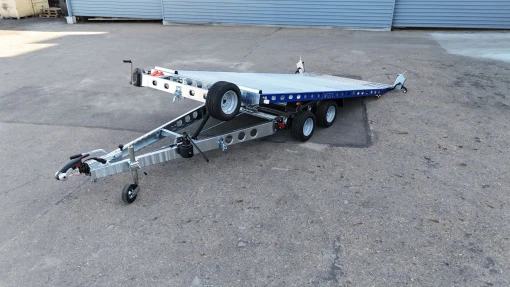


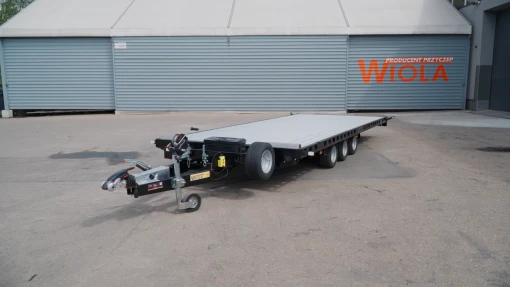
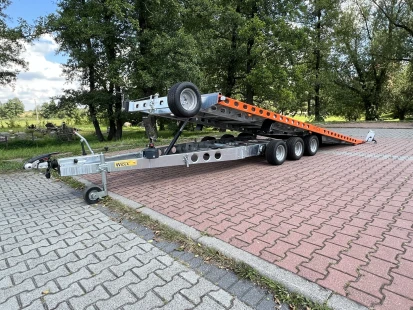


Tilting car transporters for easy loading of cars
A tilting car transporter features a transport platform that can be lowered towards the ground. This creates a gentle ramp, allowing the car to drive directly onto the loading area.
In Wiola models, the platform’s tilting mechanism is hydraulically operated. This solution speeds up the preparation of the tow truck for loading and reduces the need to manually position long ramps. Once the car has been placed on the platform, the trailer returns to its transport position, and the vehicle can be secured using straps.
A tilting car transporter trailer is ideal for transporting:
- passenger cars,
- sports cars and tuned cars,
- vintage cars,
- electric vehicles,
- damaged cars,
- vehicles unable to drive unaided,
- small delivery vans,
- vehicles intended for competitions, trade fairs and exhibitions.
Low-loader tow trucks with a low approach angle
The most important advantage of a low-loader is the low height of the platform above the road surface. Combined with a tilting design, this allows for a low approach angle, which is particularly important when transporting vehicles with low ground clearance.
On a standard car transporter, the front bumper, splitter, sills or chassis components of a low-slung car may scrape the ground when driving onto the platform. A car transporter with a low approach angle reduces this risk and makes it easier to manoeuvre the vehicle safely onto the platform.
The low-loader design also lowers the centre of gravity of the entire combination. This can have a positive effect on stability whilst driving, particularly when the car is correctly positioned and the load is properly distributed. Tow trucks of this type are often chosen by companies carrying out regular long-distance transport.
Car transporter for low-slung cars and sports cars
A tow truck for low-slung cars should ensure as smooth a transition as possible between the road surface and the transport platform. This is particularly important for sports cars, which often have lowered suspension, extended bumpers, side skirts or aerodynamic components situated close to the road surface.
A tilting car transporter can be used to transport:
- racing cars,
- rally cars,
- track day vehicles,
- classic cars,
- luxury cars,
- vehicles with modified suspension,
- cars with a long front overhang.
When loading, check the ground clearance not only under the front bumper, but also under the sills and the central part of the chassis. For particularly low cars, additional measures may be required to reduce the approach angle.
Hydraulically tilting car transporter
A hydraulically tilting car transporter uses a cylinder and a hydraulic system to lower and raise the platform. Operation does not require the user to lift the entire structure by hand, which increases convenience during frequent vehicle loading.
A hydraulic tilting platform is particularly practical for transport companies, car dealerships, garages and businesses involved in importing cars. It allows the car transporter to be prepared for work more quickly and reduces the number of separate components required for loading.
Depending on the model, a hydraulic car transporter may have a platform approximately 4–6.5 m long, two or three axles, and a gross vehicle weight rating (GVWR) suited to the type of vehicles being transported. For example, the L27G45P model has a platform measuring 4,000 × 2,040 mm and a gross vehicle weight rating of up to 2,700 kg, whilst the three-axle L35G65P has a platform measuring 6,500 × 2,040 mm and a gross vehicle weight rating of up to 3,500 kg.
Two-axle tilting car transporter
A two-axle tilting car transporter is a versatile solution for transporting most passenger cars. The two axles allow the weight of the trailer and the vehicle being transported to be distributed evenly, whilst maintaining good manoeuvrability.
Shorter models are particularly suitable for transporting standard passenger cars, sports cars and damaged vehicles. Before making a choice, you should compare the length and width of the platform with the dimensions of the vehicles you will most frequently be transporting.
The actual load capacity is also important; this is calculated by subtracting the trailer’s kerb weight from its gross vehicle weight rating. The weight of the car must be added to the equipment carried on the trailer, spare wheels, parts and any other load.
Three-axle tilting car transporter
A three-axle tilting car transporter may have a longer platform and be designed to transport larger vehicles. The three axles help to distribute the weight across a greater number of wheels, which is important for long car transporters with a gross vehicle weight rating (GVWR) of 3,500 kg.
The longer loading area allows for the transport of cars with a longer wheelbase, vans and other vehicles that do not fit on a standard platform.
However, it is important to bear in mind that a three-axle trailer offers greater resistance when manoeuvring in tight spaces. It is therefore advisable to match the number of axles to the length of the trailer, the type of vehicles being transported and the conditions in which the trailer will most frequently be used.
A winch for loading immobilised vehicles
A recovery vehicle used to transport damaged cars should be fitted with a winch. This enables a vehicle that cannot be started or cannot be driven onto the platform safely to be pulled onto it.
Wiola tow trucks are fitted with, amongst other things, an AL-KO manual winch with a pulley block. Depending on the chosen configuration, it may be possible to use a battery-powered electric winch with a remote control.
When hoisting a car, ensure that:
- the winch rope is unwinding correctly,
- the hook is secured at the correct point on the vehicle,
- the car’s wheels are aligned straight,
- there are no unauthorised persons on the platform,
- the vehicle’s weight is within the specifications of the winch and the tow truck.
Stability during travel and safe transport of the vehicle
The vehicle being transported must be positioned on the tow truck in such a way as to maintain the correct load on the coupling. Too much load may overload the rear axle of the towing vehicle, whilst too little may lead to dangerous swaying of the trailer.
Selected low-loader car transporters are fitted with a driving stabiliser, which helps to ensure stable handling of the combination. However, this does not replace correct load distribution, appropriate tyre pressure and proper securing of the vehicle.
The vehicle must be secured using straps designed for vehicle transport. The straps should be attached to the appropriate points on the tow truck, and their tension should be checked again after travelling the first few kilometres.
Equipment for tilting car transporters
The right configuration enhances the tow truck’s functionality and allows it to be adapted to the type of transport required. Depending on the model, the equipment may include:
- a hydraulically tilting platform,
- a manual or electric winch,
- a stabiliser,
- a support wheel,
- a spare wheel,
- wheel chocks,
- full LED lighting,
- axle shock absorbers,
- coupling protection,
- strap attachment points,
- aluminium platform decking,
- waterproof plywood floor,
- \a floor made of sheet metal or aluminium panels.
The equipment should be selected according to the frequency of use, the type of vehicles being transported and the conditions in which the car transporter will be operating.
Aluminium platform panelling
The perforated surface of the car transporter allows the wheels of the vehicle being transported to be secured in multiple positions. The trailer can also be fitted with a central platform infill.
A solid floor makes it easier to move around on the trailer and to transport vehicles with non-standard wheelbases. It can also be useful when transporting motorbikes, quads, small machinery and loose equipment, provided that each item is properly secured.
Depending on the model, you can choose between fillings made of plywood, aluminium sheet or aluminium panels.
Galvanised tow truck structure
The tow truck’s frame must withstand frequent loading, high mileage and operation in varying weather conditions. Wiola low-loader trailers are manufactured from high-strength structural steel, and their surfaces are protected against corrosion by hot-dip galvanising.
Regular inspection of the structure, axles, brakes, tyres, coupling and hydraulic system helps to maintain the trailer’s operational readiness during intensive use.
Who is the low-loader designed for?
Tilting car transporters are chosen by both private customers and professional car transport companies.
They are particularly well-suited for:
- transport companies,
- car dealerships,
- garages and service centres,
- car hire companies,
- motorsport teams,
- car importers,
- breakdown services,
- collectors of classic cars,
- companies organising motoring fairs and events.
If you frequently transport sports cars or damaged vehicles, a tilting platform can significantly streamline your day-to-day operations.
How to choose a tilting car transporter?
Before purchasing, you should determine which vehicles will be transported most frequently. The most important parameters are the length and width of the platform, kerb weight, payload, number of axles and gross vehicle weight.
It is also worth paying attention to:
- the approach angle,
- the method of operating the hydraulics,
- platform length,
- the dimensions of the vehicles being transported,
- the vehicle’s wheelbase,
- availability of a winch,
- the layout of the securing points,
- type of floor covering,
- the specifications of the towing vehicle,
- driving licence category held.
For standard passenger cars, a shorter two-axle model may be sufficient. For larger vehicles and frequent transport, it is worth considering a longer three-axle tow truck with a maximum authorised mass of up to 3,500 kg.
Wiola tilting car transporters – choose the right model
Wiola’s range includes tilting car transporters and low-loader car transporters in various sizes, with different numbers of axles and gross vehicle weights. Individual models can be used to transport standard passenger cars, low-slung sports cars, classic cars and broken-down vehicles.
A hydraulically tilting platform, low ramp angle, winch and stabiliser facilitate loading and the safe transport of the vehicle. Compare the available models and choose a tow truck suited to your towing vehicle and the type of transport you carry out.
FAQ – tilting and low-loader car transporters
How does a tilting car transporter work?
The tow truck’s platform is lowered hydraulically towards the ground, creating a gentle ramp. Once the vehicle has been loaded, the platform is raised to the transport position.
How does a low-loader differ from a standard car transporter?
A low-loader has a lower-set platform and smaller wheels. This allows for a shallower approach angle, making it easier to load sports cars and vehicles with low ground clearance.
Is a tilting car transporter suitable for a low-slung car?
Yes. The hydraulically tilting platform and low-loader design are intended, amongst other things, for the transport of cars with lowered suspension.
Does a tilting car transporter have ramps?
On low-loader car transporters, the tilting platform forms an integrated ramp. This means there is no need to set up long, separate ramps.
Is a 3,500 kg tilting car transporter available?
Yes. Selected three-axle models can have a maximum authorised mass (MAM) of up to 3,500 kg. You should always check their actual load capacity and the specifications of the towing vehicle.
Can a tilting car transporter carry a broken-down vehicle?
Yes. A vehicle that cannot drive onto the platform under its own power can be loaded using a winch.
Is a two-axle or three-axle flatbed trailer better?
A two-axle model is usually easier to manoeuvre and is sufficient for transporting most passenger cars. A three-axle model may offer a longer platform and better weight distribution, but it is more difficult to manoeuvre in tight spaces.