(32) 232 19 65

Articles
Car Towing Trucks – A Guide – Types of Towing Trucks – Which Towing Truck Should You Buy?
Car transporters are trailers designed to transport vehicles: damaged ones, new ones that have not yet been registered, those imported without a valid MOT in Poland, or even classic cars. They are usually 400 cm long and 200 cm wide. A car transporter falls into the heavy goods vehicle category – in order to carry a passenger car weighing 1200–1400 kg, its GVW (gross vehicle weight) must be at least 2000 kg. It is worth remembering that the towing vehicle should have sufficient towing capacity at the tow bar. We have covered this aspect in more detail in our article ‘How to choose a trailer for your car’.
Virtually any passenger car can be loaded onto such a trailer. In this guide, we’ll outline the types of car transporters available on the market and the advantages and disadvantages of each option.
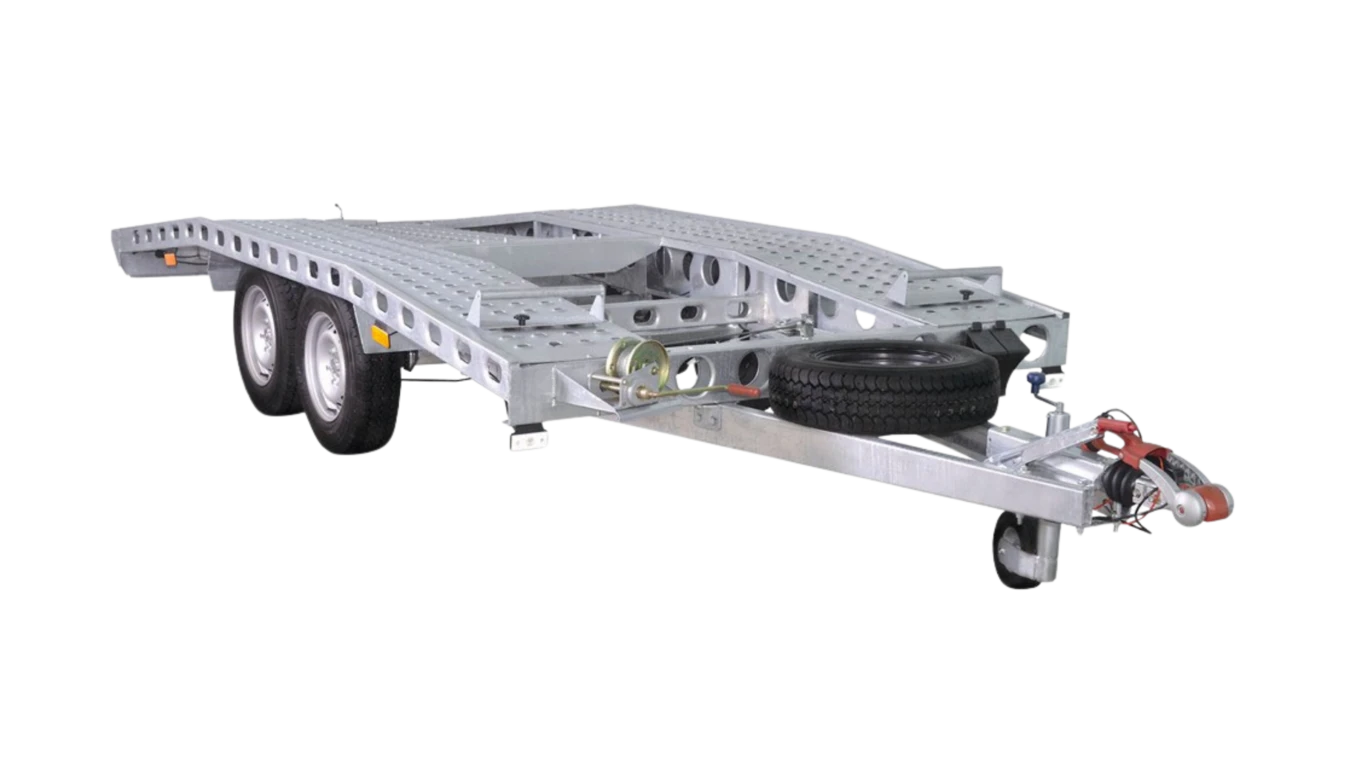
"Beetle" type tow truck
with wheels under the floor
This is a common term for two-axle flatbed trailers with wheels underneath, which do not have a flat floor and whose upper frame is shaped like an inverted U – e.g. the Wiola L27G40. The front and rear sections are ‘sloped’, whilst the central section is flat.
One of the main advantages of this solution is that it lowers the vehicle’s centre of gravity, meaning the loaded car sits a few centimetres lower. It also reduces the angle of approach between the ramps and the tow truck’s frame. Another significant benefit is the width, as the trailer’s wheels do not protrude beyond its outline – we can easily fit into any lane on the road.
The only difficulty may arise when loading a car with very low ground clearance (e.g. sports cars). In such cases, it is worth considering another option – ordering a tow truck with a straight front frame.
Car transporters are also available in larger versions, offering load capacities of up to 3,500 kg. A very popular trailer for transporting minibuses and vans is, for example, the Wiola L30G50, which offers a load capacity of over 2,300 kg and is 500 cm long.
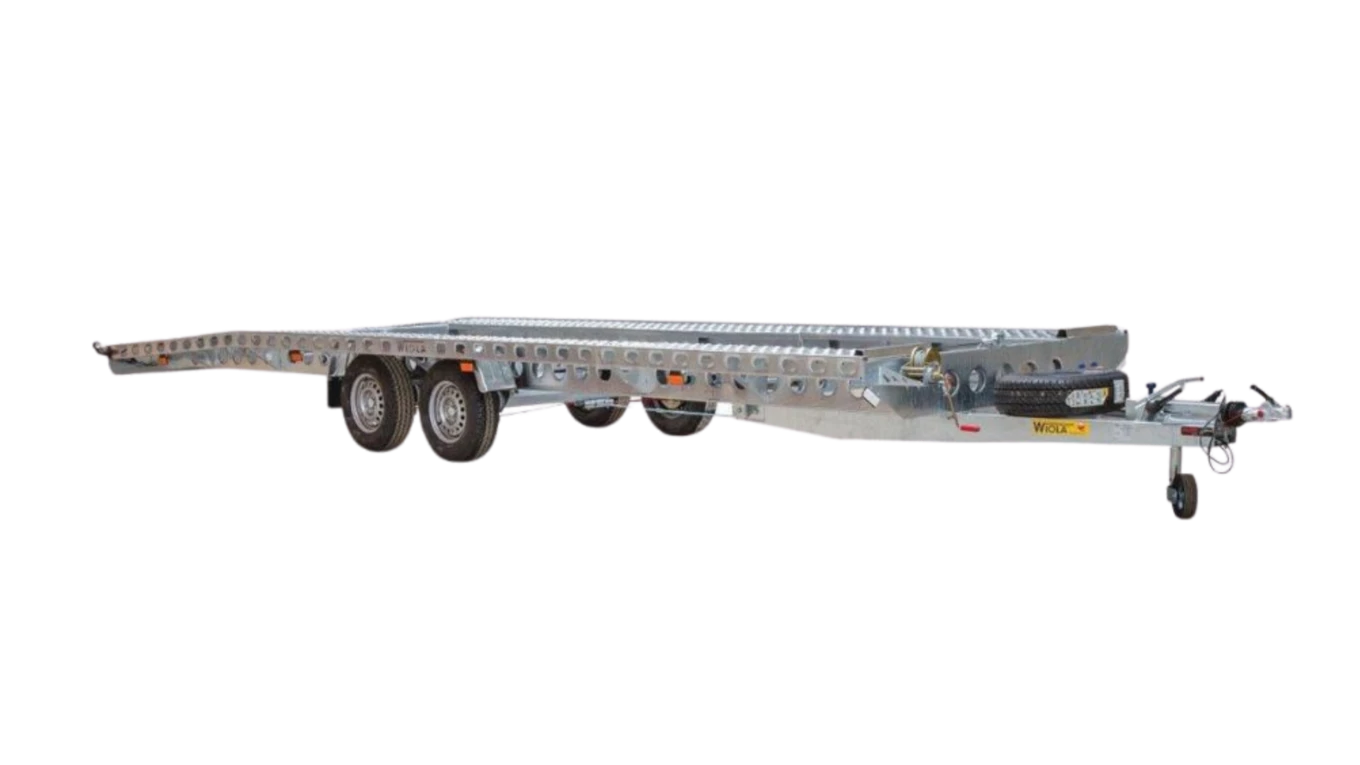
Double car transporter
for two cars
They are also known as ‘humpbacks’ because their wheels are tucked away beneath the chassis. They are designed to transport two cars at the same time. They are available in two- or three-axle versions. They are usually 750–850 cm long (e.g. Wiola L35G80) and have a load capacity of around 2,500 kg. They are most commonly used by transport companies specialising in car imports.
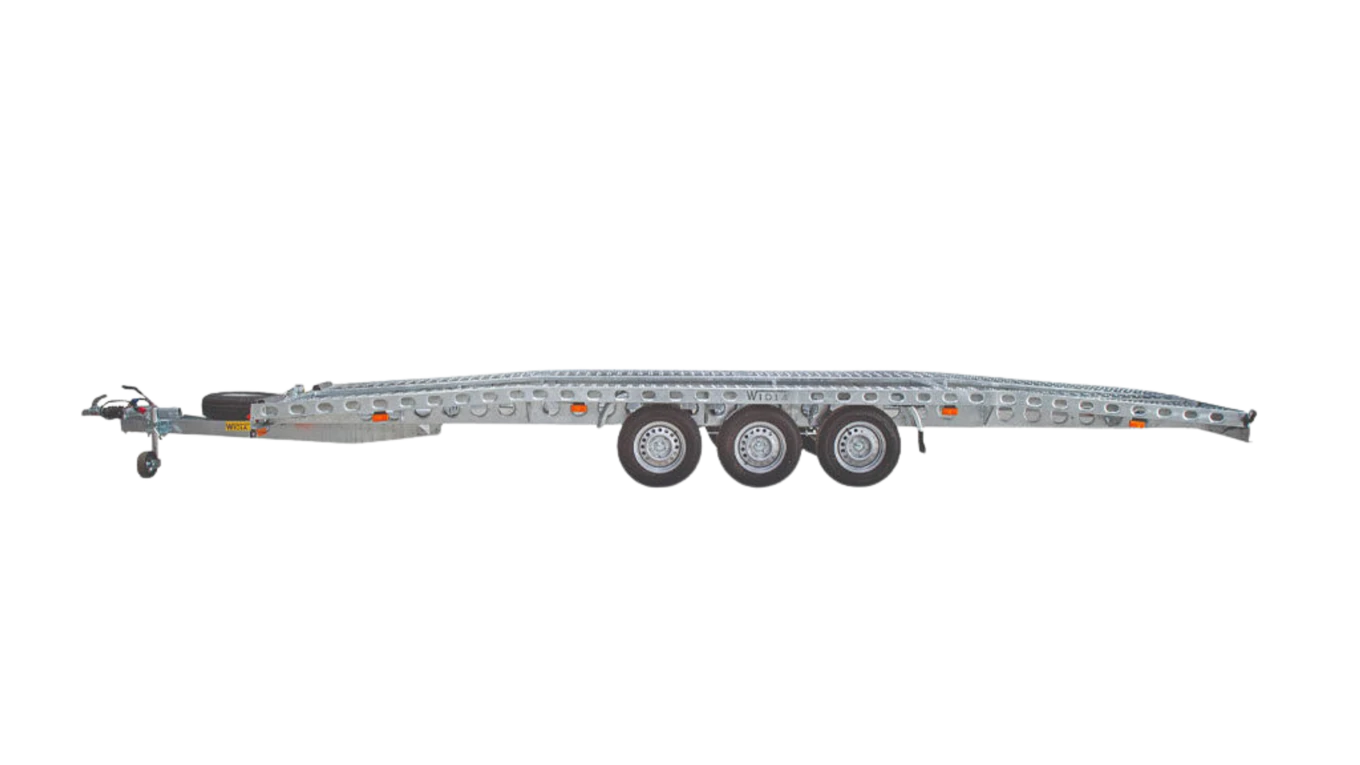
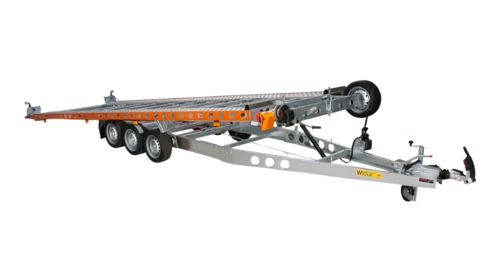
Three-axle models have recently become more popular; users particularly praise their improved weight distribution and lower load on the tow ball (e.g. the Wiola L35G85 3-axle). The downside of three-axle car transporters is their reduced manoeuvrability. Three wheels on each side create significant resistance during tight manoeuvres and when turning round.
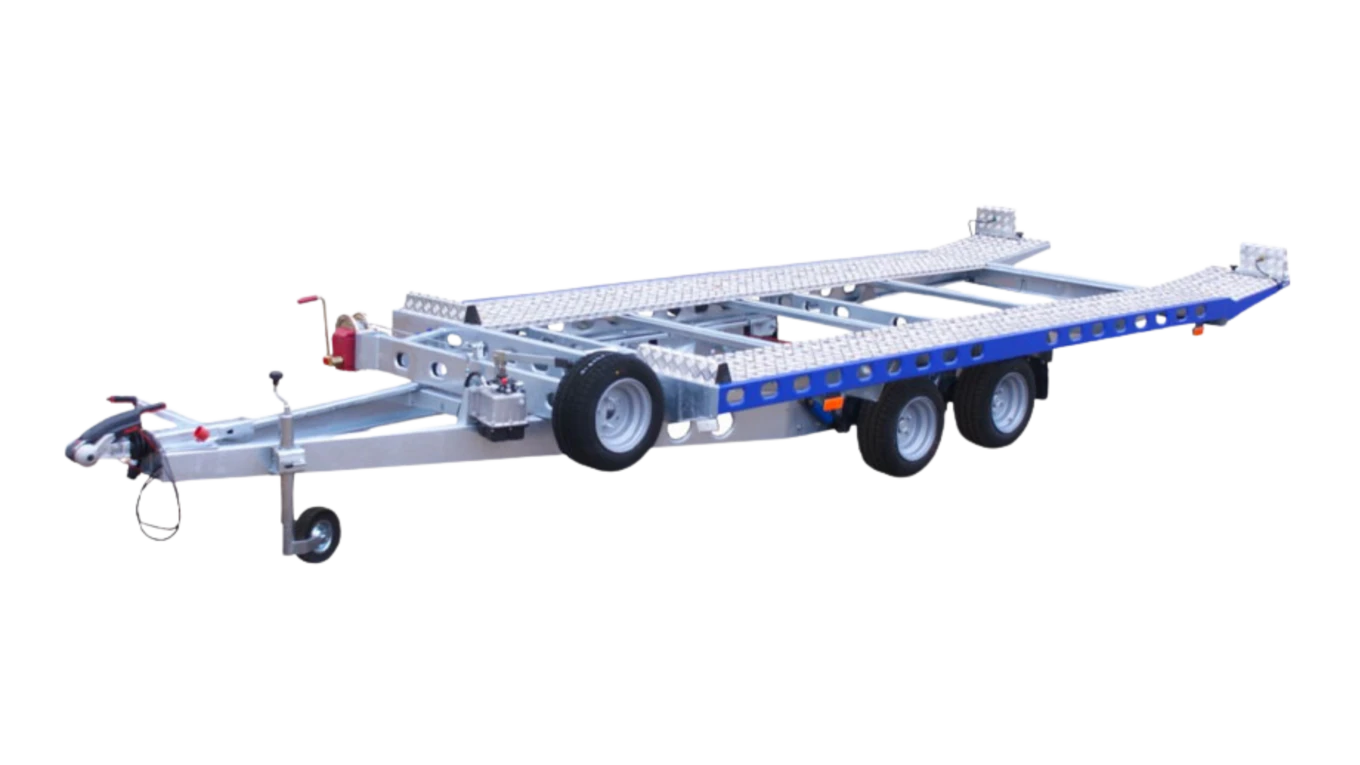
Tilting car transporter
In Poland, this type of car transporter became popular around 10 years ago, when the condition of our roads improved significantly. They are characterised by small wheels and low-profile tyres (the most commonly used are 195/55R10C). The ramps are integrated, and the frame tilts using a hydraulic cylinder. This design makes loading cars much easier, thanks to the low approach angle. Furthermore, the low chassis and low-profile tyres lower the combination’s centre of gravity, making driving with such a trailer more stable.
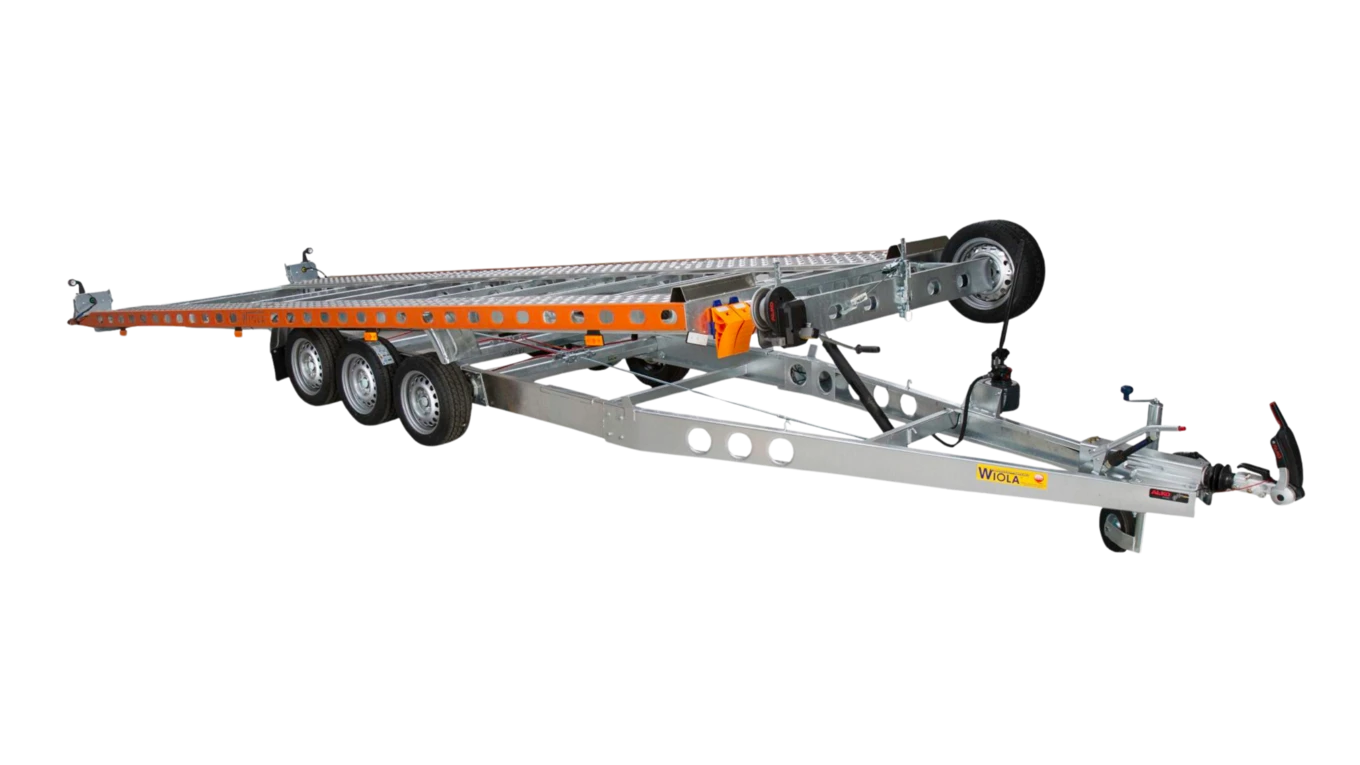
Car transporters of this type are favoured by companies that cover long distances. It is also often said that these are ideal car transporters for motorways. Wiola manufactures this type of trailer in several variants: 400 cm long (L27G45P) and 650 cm long (L35G65P).
For transporting sports cars, lowered cars and vehicles with low ground clearance, low-loader and tilting car transporters are the best choice. At Wiola, these models are designated with the suffix ‘low’, e.g. L27G45P low, L35G65P low.
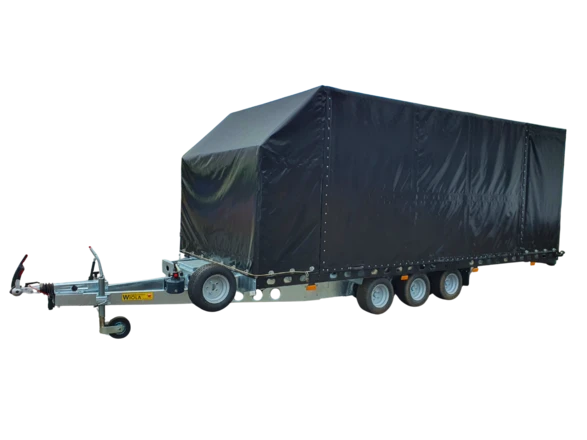
Enclosed and tilt-top car transporters are designed for the transport of classic, sports and rally cars. This is the ideal solution for motoring and racing enthusiasts who wish to transport and store their cars safely in all weather conditions.
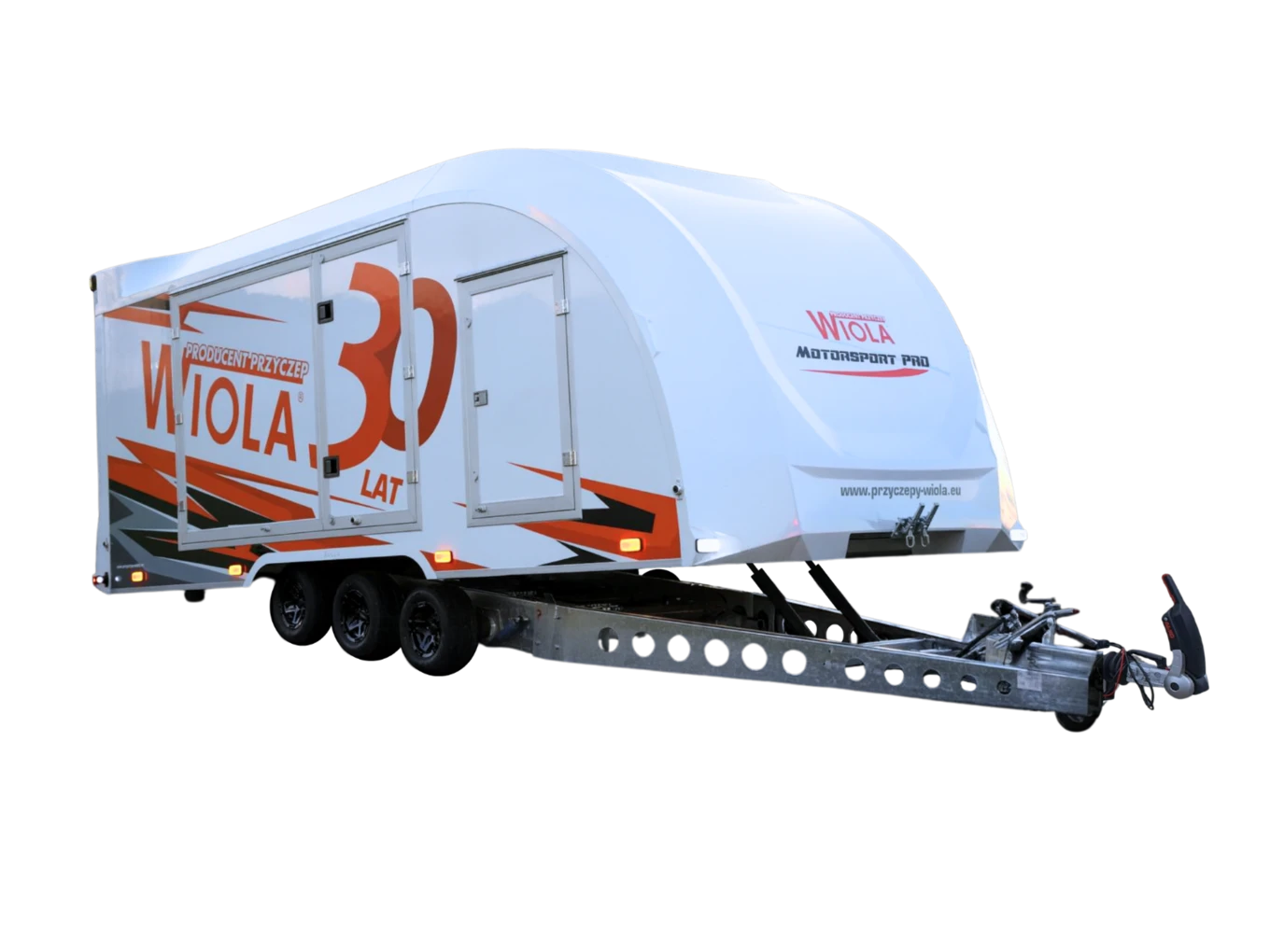
Wiola’s range includes enclosed tow lorries with tarpaulin covers:
As well as a model with a body made from laminate and sandwich panels:
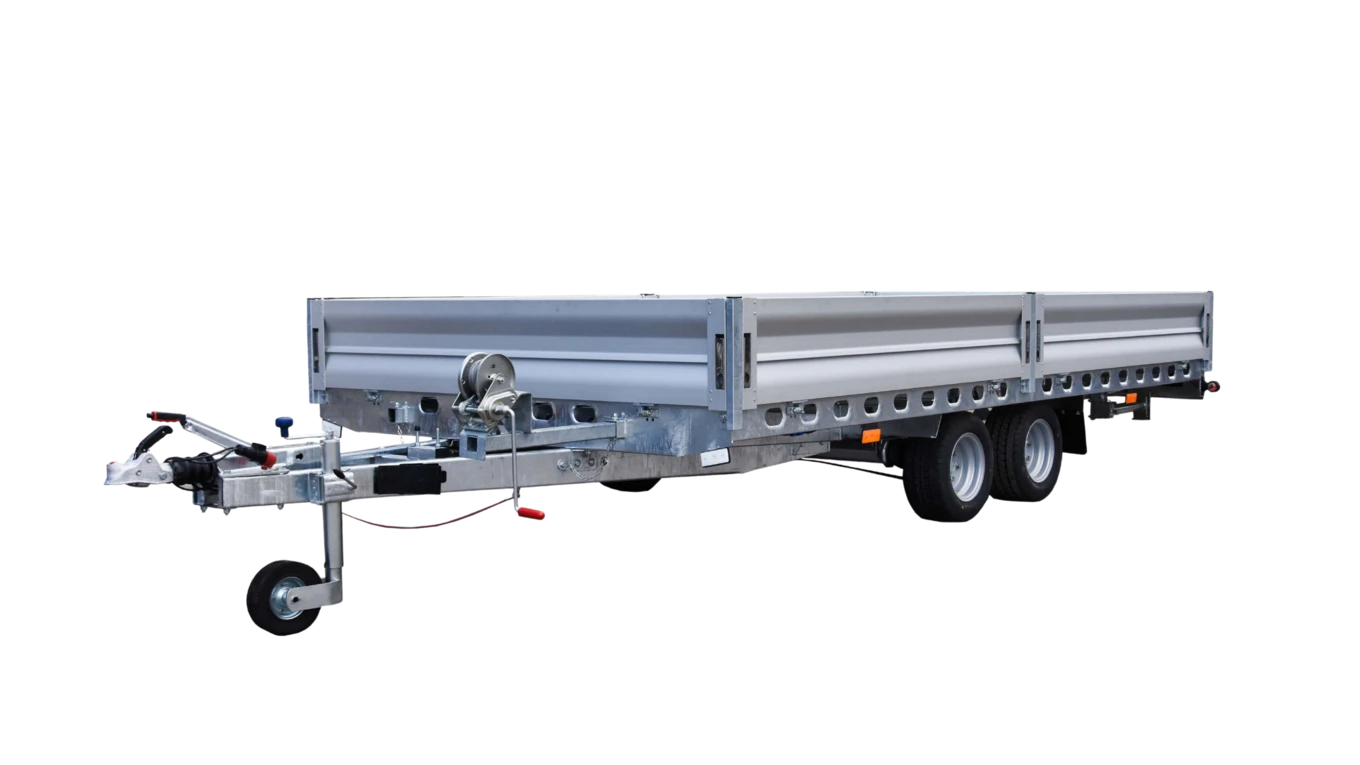
Multitrailer trailers
universal
Since the start of 2019, our range has also included multi-purpose trailers – the Multitrailer line. This range is characterised by its ability to transport both goods and vehicles. The trailer can be fitted with removable side panels (steel or aluminium) and ramps that fold away under the floor. The floor itself is made of waterproof, non-slip plywood or aluminium panels, with additional cut-outs for securing straps. At the front, there is a socket for attaching a tow bar.
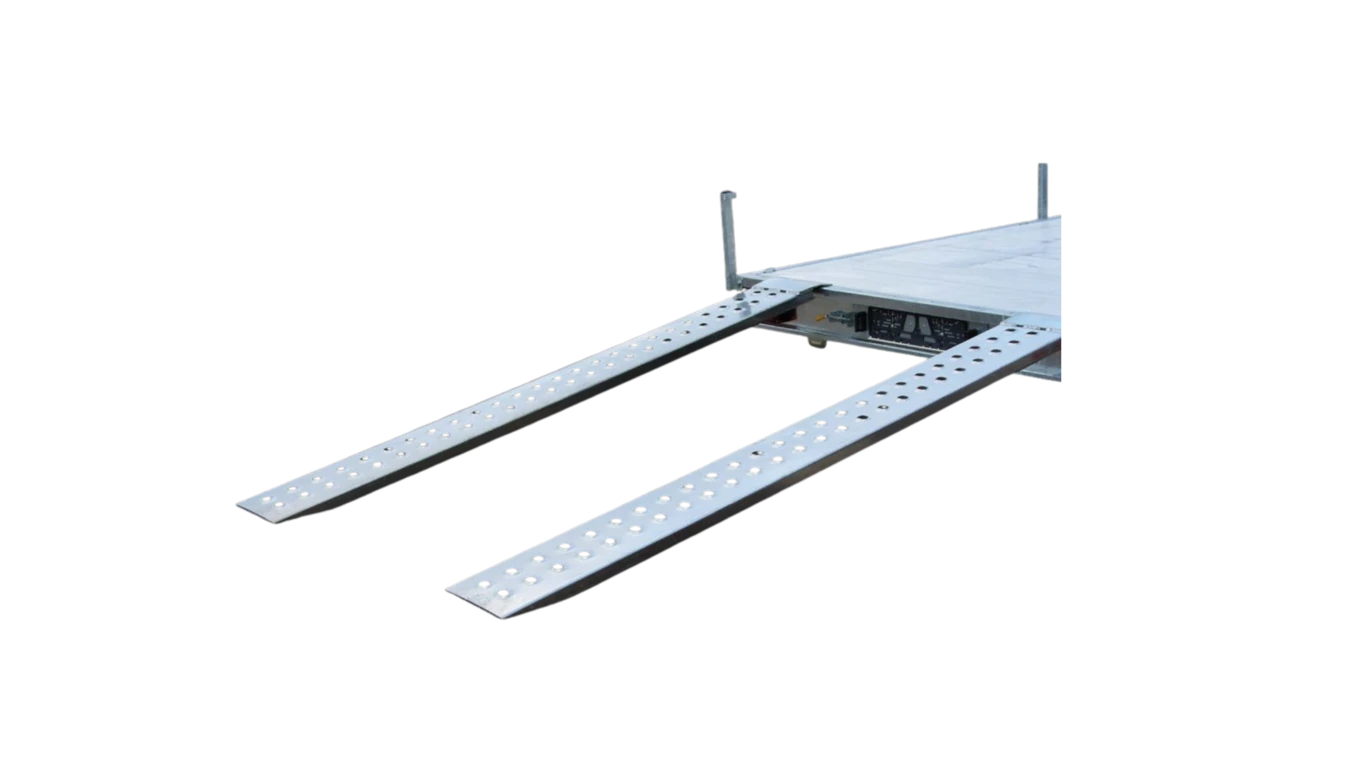
Trailers of this type are becoming increasingly popular. A tarpaulin can also be ordered for them.
Thanks to the lowered frame and the use of 195R13C wheels with low-profile tyres, the trailer also has a low loading sill.
Multitrailer universal trailers are available in several variants: with a gross vehicle weight ranging from 2,000 to 3,500 kg.
Equipment and accessories
- A
tow truck should be fitted with a manual or electric winch. It is worth paying attention to this feature, as trailer manufacturers often fit Chinese models that stop working after a few months. In such cases, it is worth paying a little extra for a winch from a reputable manufacturer, such as AL-KO.
- Ramps Both steel and aluminium ramps
are used. The former are very sturdy, but also heavy. Aluminium ramps are almost half the weight, but it is important to bear in mind that they may bend under heavy loads. It is therefore important to check the maximum load capacity specified by the manufacturer.
- Ride Stabiliser
For the past 10 years, Wiola has been fitting AL-KO’s AKS towbar with a ride stabiliser to most of its car transporter models. This solution has been adapted from caravans, which, like car transporters, have a high centre of gravity. The coupling with a stabiliser reduces trailer sway on the road, e.g. in the event of a sudden lane change. The AKS coupling works by pressing down on the tow ball at four points with a force of approx. 1,500 kg.
- LED lighting
It is definitely worth paying a little extra for lights using LED technology, including both rear combination lamps and side marker lights. This solution not only looks good, but is also virtually fault-free and does not require bulb replacement, for example when the tow truck is being towed by a lorry with a 24 V electrical system or a van with a 12 V system.
Where can I buy it?
You can buy a car transporter from a dealer or directly from the manufacturer. You’ll also find plenty of listings on classifieds websites such as Allegro, Otomoto and OLX. Dealers often list their trailers there too. Prices for car transporters range from 10,000 PLN to as much as 26,000 PLN. It is worth choosing a manufacturer that offers at least a 24-month warranty. Polish car transporters are very popular both in Poland and abroad, so it is worth trusting domestic production. Wiola’s range includes over 20 standard car transporter models. Our dealer network comprises as many as 28 sales outlets across Poland.
Car transporters – types of transporters, dimensions, gross vehicle weight and load capacity
A car transporter is a trailer designed to transport passenger cars, vans, sports cars, classic cars and damaged vehicles. When choosing a car transporter, you should compare not only its price, but above all its gross vehicle weight rating (GVWR), kerb weight, actual load capacity, the length and width of the loading platform, the number of axles and the method of loading the vehicle. One type of car transporter will be suitable for the occasional transport of a small car, whilst another will be better suited to transporting minibuses, sports cars or two vehicles at the same time.
A well-chosen car transporter should be suitable for:
- the weight of the vehicle being towed,
- its length, width and wheelbase,
- the towing vehicle,
- the category of driving licence held,
- frequency of use,
- the type of routes travelled,
- the method of loading roadworthy and damaged vehicles.
In this guide, we explain the differences between single-, double- and triple-axle car transporters, how much a car transporter weighs, how to calculate its load capacity and which vehicle to choose for towing it.
What is a car transporter?
A car transporter is a specialised trailer with a platform onto which a vehicle can drive under its own power or be towed using a tow rope. In registration documents, such a vehicle may be described as a goods trailer intended for the carriage of vehicles.
Common colloquial terms include, amongst others:
- car transporter,
- car transporter trailer,
- hook-up car transporter,
- car transport trailer,
- car trailer,
- car transporter.
The term ‘car transporter’ is also sometimes used to refer to a breakdown vehicle with a fixed platform. In this guide, however, we describe car transporters that are attached to the tow bar of a towing vehicle.
A tow truck with a tow bar or a vehicle with a built-in tow platform?
A towbar-mounted car transporter is a separate vehicle that is attached to a car via a ball coupling. Once the transport is complete, it can be detached, allowing the towing vehicle to continue being used for other tasks.
A car with a built-in tow-truck body has a permanently fitted platform. It does not require a tow bar or a separate trailer, but its transport capacity is limited by the chassis’s load capacity.
A car transporter trailer will usually be a better option for:
- car dealerships,
- garages,
- transport companies,
- vehicle importers,
- motorsport teams,
- people who transport cars occasionally,
- users who do not wish to maintain a separate breakdown vehicle.
DMC of tow trucks, kerb weight and payload
Before making a purchase, it is important to distinguish between three key parameters.
The kerb weight of the tow truck
The kerb weight of a car transporter is the weight of the trailer when it is ready to drive but unladen. It includes the frame, axles, wheels, braking system and permanently fitted equipment.
The actual weight may also be affected by:
- an electric winch,
- an additional floor,
- a spare wheel,
- a toolbox,
- support legs,
- additional ramps,
- bodywork or tarpaulin,
- battery,
- additional lighting.
The final weight of a specific configuration should be checked in the trailer’s documentation.
Car transporter load capacity
The load capacity indicates how heavy a vehicle can be towed. It is calculated using the following formula:
tow truck’s load capacity = tow truck’s maximum authorised mass (MAM) – tow truck’s unladen weight
If a trailer has a GVW of 3,000 kg and weighs 800 kg, its maximum load capacity is 2,200 kg.
However, it is important to remember that the load includes not only the car itself, but also any additional items carried on the flatbed. These may include wheels, parts, tools, jerry cans, luggage or sports equipment.
How much does a car transporter weigh?
There is no single, universal answer to the question of how much a flatbed trailer weighs. The weight depends on the dimensions of the platform, the number of axles, the type of construction, the materials used and the equipment fitted.
For example:
- a lightweight single-axle car transporter – approximately 270–510 kg,
- a standard two-axle car transporter for one car – approximately 600–900 kg,
- a long car transporter for two cars – approximately 900–1,200 kg,
- a tilting car transporter with a solid floor and hydraulics – the kerb weight is often greater than that of a similar standard model.
These are approximate figures. Examples of single-axle car transporters available on the market, with a platform length of approximately 3.6–4 m, weigh between 450 and 510 kg, although very lightweight aluminium designs may weigh less.
By way of comparison, the two-axle Wiola L27G40, with a platform measuring 3940 × 1940 mm, has a kerb weight of 615 kg in one configuration, whilst the longer L30G50, with a platform measuring 4,940 × 1,940 mm, weighs approximately 785 kg. The equipment and current specifications of a particular vehicle may affect these figures.
A 3-tonne tow truck – what does that mean?
The term ‘3-tonne tow truck’ usually refers to a tow truck with a maximum authorised mass (MAM) of 3,000 kg. This does not mean that a car weighing 3,000 kg can be loaded onto it.
If the tow truck’s unladen weight is 785 kg, with a maximum authorised mass of 3,000 kg for the car and the remaining load, the calculation is as follows:
3,000 kg – 785 kg = 2,215 kg payload
When choosing a tow truck for a car weighing around 2,100 kg, this margin may be small, particularly if additional equipment is fitted. For the regular transport of heavier vehicles, it is better to allow for a reasonable margin in the load capacity.
Car transporter dimensions – how to choose the right length and width?
The dimensions of the car transporter should be chosen to suit the largest vehicles that will be transported on it on a regular basis. It is important to distinguish between the dimensions of the loading platform and the overall dimensions of the trailer.
Car transporter – platform length
The length of the car transporter affects the ability to position the car correctly and distribute its weight in relation to the trailer’s axles and the tow hook.
The most commonly used platform lengths are:
- around 4,000 mm – city cars, compact cars and most passenger cars,
- approximately 4,500 mm – larger passenger cars, estate cars, SUVs and vehicles with a longer wheelbase,
- approximately 5,000 mm – large SUVs, vans and some minibuses,
- approximately 6,000–6,500 mm – long delivery vans or specialist vehicles,
- approximately 7,500–8,500 mm – transporting two cars.
A platform that is too short may prevent the car from being positioned correctly and ensure the correct load is applied to the tow bar. The car should not be positioned solely on the basis of whether it physically fits between the start and end of the platform.
Width of the tow truck
The width of the tow truck should match the wheelbase of the vehicle being transported. Popular flatbeds are approximately 1940–2040 mm wide.
When transporting wide SUVs, sports cars or minibuses, you need to check:
- the vehicle’s wheelbase,
- tyre width,
- the distance between the outer edges of the wheels,
- the position of the tow truck’s mudguards,
- the width of the ramps,
- access to the securing points.
The overall width of the trailer may be greater than the width of the loading area itself.
Wiola’s current range of standard car transporters includes platforms with widths of approximately 1,940 and 2,040 mm and lengths ranging from approximately 3,940 mm to over 8 metres.
Single-axle tow truck
A single-axle trailer has one axle and two wheels. It is usually lighter, more manoeuvrable and easier to move by hand than larger tandem designs.
Its advantages include:
- low kerb weight,
- good load capacity relative to the maximum authorised mass,
- easy manoeuvrability,
- simpler design,
- fewer tyres and suspension components,
- lower maintenance costs.
A potential limitation may be reduced stability when carrying a heavy load and greater sensitivity to incorrect positioning of the vehicle being transported.
Weight of a single-axle trailer
The weight of a single-axle car transporter can range from around 270 kg for a very lightweight aluminium design to over 500 kg for a steel model with a platform approximately 4 metres long.
However, you should not choose a car transporter solely on the basis of its low kerb weight. You must also assess the strength of the frame, the load-bearing capacity of the axles, the width of the platform and the quality of the securing points.
DMC car transporters
The DMC of a car transporter – that is, the maximum permissible mass – specifies the maximum weight of the trailer together with the car being transported, its equipment and any other load.
The DMC does not, therefore, indicate how much the car on the platform can weigh.
Two-axle tow truck, tandem and two-axle tow truck
A two-axle tow truck has two axles positioned close together. This configuration is also referred to as a tandem, which is why the terms ‘tandem tow truck’, ‘2-axle tow truck’ and ‘two-axle tow truck’ often refer to the same type of design.
The two axles ensure:
- stable handling,
- good load distribution,
- less tilting during loading,
- the possibility of a higher gross vehicle weight,
- a larger loading area,
- greater safety in the event of a single tyre failure.
A tandem car transporter is the most popular choice for the regular transport of passenger cars. It is ideal for use in garages, second-hand car dealerships, car hire companies and transport firms.
Its disadvantage is its higher kerb weight and greater resistance when manoeuvring in tight spaces compared to a single-axle tow truck.
Three-axle car transporter trailer
A three-axle car transporter has three axles and six wheels. It is most commonly used in long models designed to transport two cars, minibuses or specialist vehicles.
The three axles allow the weight to be distributed across a greater number of wheels. However, they do not automatically increase the maximum authorised mass (MAM) to over 3,500 kg in the case of typical trailers towed by Category B cars.
The key advantages of a three-axle car transporter are:
- the stability of the long platform,
- good load distribution,
- a large number of support points,
- the ability to transport long vehicles,
- good handling on longer journeys.
The disadvantages include a higher kerb weight, higher tyre costs and high tyre resistance when making tight turns and reversing.
For example, the Wiola L35G80 three-axle car transporter has a platform 7,940 mm long, 2,040 mm wide and a maximum authorised mass (MAM) of up to 3,500 kg.
Humpback tow truck – wheels under the platform
A humpback trailer, also known as a ‘humpback’, has its wheels positioned beneath the platform. Its frame is not completely flat – the front and rear sections are sloped, whilst the central part of the platform is higher.
The main advantages of the humpback trailer are:
- wheels that do not protrude far beyond the platform,
- a narrow overall width,
- good use of available space,
- the ability to use standard wheels with a larger diameter,
- a simple and robust design,
- easy access to components.
The sloping rear of the platform helps to minimise the angle between the ramps and the loading surface. However, with very low-slung sports cars, the transition between the different sections of the chassis can be a problem.
For such vehicles, a low-profile tow truck with a tilting platform may be a better option.
Tilt-bed lorries and low-loader lorries
Tilting car transporters have a platform that can be tilted towards the ground. This reduces the approach angle and makes it easier to load cars with low suspension.
A low-profile car transporter will be particularly useful for transporting:
- sports cars,
- racing and rally cars,
- vintage cars,
- cars with aerodynamic add-ons,
- cars with damaged suspension,
- vehicles with low ground clearance.
The platform can be tilted mechanically, by gravity or hydraulically. In hydraulic models, operation is facilitated by a cylinder and, in certain configurations, also by an electric pump.
Wiola tilting flatbed trailers are available as two- and three-axle models. For example, the L30G45P has a platform measuring 4000 × 2040 mm, two axles, 195R10C tyres and hydraulic tilting. The longer L35G65P has a platform measuring 6500 × 2040 mm and three axles.
10-inch wheeled car transporter – reviews, pros and cons
People looking for reviews of a tow truck fitted with 10-inch wheels are most often concerned about the durability of the small tyres and the ride comfort.
The advantages of 10-inch wheels
The small wheels allow the platform to be positioned lower. As a result:
- the loading height is reduced,
- a gentler approach angle can be achieved,
- it is easier to load a low-slung vehicle,
- the centre of gravity of the loaded combination is lowered,
- the wheels can be positioned underneath the platform.
Disadvantages of 10-inch wheels
A smaller wheel makes more revolutions over the same distance than a wheel with a larger diameter. That is why the following are particularly important:
- correct tyre pressure,
- the correct load index,
- tyres designed for trailers,
- monitoring tyre temperature and condition,
- serviceable bearings,
- not exceeding the tow truck’s maximum authorised mass.
A professional car transporter should not be fitted with random car tyres that lack sufficient load-bearing capacity. Wiola models are fitted with, amongst other things, reinforced 195R10C tyres.
A tow truck with 10-inch wheels is a good choice when a low ground clearance is a priority. For driving on very poor road surfaces, some users may prefer larger 13- or 14-inch wheels.
A tow truck for transporting a minibus
A tow truck for transporting a minibus must be of the appropriate length, width and load capacity. Vans are usually heavier and have a longer wheelbase than passenger cars.
Before making a choice, you need to check:
- the actual weight of the minibus,
- its overall length,
- its wheelbase,
- the wheel width,
- height and ground clearance,
- the position of the centre of gravity,
- the ability to set the correct load on the tow bar.
A tow truck approximately 5 metres long with a maximum authorised mass (MAM) of 3,000–3,500 kg may be sufficient for transporting a smaller delivery van. Longer minibuses may require a 6–6.5-metre platform.
Not every van will fit within the load capacity of a tow truck with a GVW of 3,500 kg. If the trailer weighs 900 kg, that leaves around 2,600 kg for the vehicle and any other equipment.
A tow lorry for two cars
A car transporter designed to carry two cars is usually between approximately 7.5 and over 8 metres long. It may have two or three axles.
Before purchasing, you should calculate the combined weight of both vehicles. In practice, a car transporter with a gross vehicle weight rating (GVWR) of 3,500 kg and a kerb weight of around 1,000 kg offers a payload of around 2,500 kg. This means that not every pair of modern cars will fit within the permitted limit.
A long car transporter is particularly suitable for transporting:
- two small cars,
- city cars,
- vintage vehicles,
- light sports cars,
- a car and motorbikes,
- a car together with its parts and additional equipment.
What sort of car is best for towing a recovery vehicle?
The vehicle towing the car transporter must be authorised to tow a trailer with the appropriate maximum authorised mass. The key details can be found in the vehicle registration certificate.
You need to check:
- O.1 – the maximum gross weight of the braked trailer,
- O.2 – the maximum gross weight of the trailer without brakes,
- F.3 – the maximum authorised mass of the entire vehicle combination,
- the permissible load on the tow bar,
- the rated capacity of the fitted coupling device.
Field O.1 does not indicate how much the currently loaded trailer weighs, but rather the maximum mass of a braked trailer specified for the vehicle in question. The significance of fields O.1, O.2 and F.3 is derived from the format of the registration certificate.
Apart from the formal requirements, it is worth choosing a car that has:
- an appropriate kerb weight,
- a long wheelbase,
- effective brakes,
- stable suspension,
- sufficient torque,
- an efficient cooling system,
- a drivetrain that provides traction when pulling away,
- a manufacturer that authorises the towing of a heavy trailer.
A large engine is no substitute for the correct type approval. Even a powerful car cannot legally tow a trailer with a maximum authorised mass (MAM) higher than that permitted by the manufacturer and specified in the vehicle documents.
What category of driving licence is required to drive a car transporter?
The licence requirements depend on the vehicle’s maximum authorised mass (MAM) and the trailer’s maximum authorised mass (MAM), rather than on the number of axles on the tow truck.
Category B
A Category B driving licence allows you to drive:
- a car with a maximum authorised mass (MAM) of up to 3,500 kg with a light trailer with a MAM of up to 750 kg,
- a car with a maximum authorised mass (MAM) of up to 3,500 kg with a trailer other than a light trailer, provided that the combined MAM of the entire combination does not exceed 3,500 kg.
A typical car transporter has a maximum authorised mass exceeding 750 kg. It may only be driven with a standard Category B licence if the combined maximum authorised mass of the car and the transporter does not exceed 3,500 kg.
Category B with code 96
Code 96 allows the holder to drive a combination comprising a Category B car and a trailer other than a light trailer, provided that the combined maximum authorised mass (MAM) of the combination exceeds 3,500 kg but does not exceed 4,250 kg.
To obtain Code 96, you must pass an additional practical test.
Category B+E
A B+E licence allows you to drive a category B vehicle with a trailer with a maximum authorised mass (MAM) of up to 3,500 kg.
For most combinations consisting of a large SUV, a van or an off-road vehicle and a car transporter with a maximum authorised mass of 2,700–3,500 kg, a B+E licence will be required.
The current rules regarding Category B, code 96 and Category B+E are set out on the official government website.
Car transporter – what licences do you need to check before setting off?
Before coupling the tow truck, you must check the following at the same time:
- the driver’s driving licence category,
- the vehicle’s maximum authorised mass (MAM),
- the tow truck’s maximum authorised mass (MAM),
- the combined GVW of the combination,
- the O.1 value in the vehicle registration document,
- the F.3 value,
- tow bar specifications,
- the actual weight of the vehicle being transported,
- the actual mass of the fully loaded car transporter.
Simply holding a B+E licence does not mean that any car can tow a car transporter with a maximum authorised mass (MAM) of 3,500 kg. Technical restrictions on the car and the tow bar still apply.
What a good car transporter should be equipped with
A tow truck’s functionality is not determined solely by its chassis and the number of axles. It is worth paying attention to the equipment that makes it easier to load and secure the vehicle.
Pull-on device
A tow truck is required to load damaged, faulty or otherwise unserviceable vehicles that cannot be driven safely onto the platform.
It can be:
- manual,
- battery-powered,
- electric with remote control.
Its pulling capacity should be appropriate for the weight of the vehicles.
Uphill sections
Steel ramps are sturdy but heavier. Aluminium ones are easier to carry, but their load-bearing capacity must be suitable for the vehicle being transported.
Their length is also important. A longer ramp allows for a gentler angle of approach.
Mounting points
The tow truck should allow the car to be secured by its wheels using suitable transport straps. The attachment points must be positioned so that the straps can be routed correctly, regardless of the car’s size.
Stability control
A stabiliser reduces uncontrolled movements of the trailer relative to the towing vehicle. However, it is no substitute for correct load distribution, appropriate weight on the tow bar and adjusting your speed.
Spare wheel
A car transporter travelling long distances should be fitted with a spare wheel. The size, load index and type of tyre must correspond to those fitted to the trailer.
LED lighting
LED lighting improves the trailer’s visibility and reduces the need to replace bulbs. It is particularly important that the rear lights, side marker lights and number plate lights are in good working order.
Which car transporter should I buy?
You can simplify your choice by selecting the type of tow truck that suits your intended use:
- occasional transport of a light vehicle – a single-axle or light twin-axle car transporter,
- regular transport of passenger cars – a tandem twin-axle car transporter,
- sports cars and low-slung vehicles – a tilting low-loader,
- large SUVs and vans – a 3-tonne or 3.5-tonne tow truck with a platform approximately 5 m long,
- long minibuses – a tow truck 5–6.5 metres long,
- two light vehicles – a two- or three-axle car transporter approximately 8 m long,
- general-purpose transport of cars and goods – a trailer-type car transporter with a full platform,
- professional long-distance transport – a braked tow truck with a winch, stabiliser and shock absorbers.
Before making a purchase, it is worth finding out the details of the heaviest and longest vehicle that will be towed. You should then check the specifications of the towing vehicle and, based on this, determine the appropriate gross vehicle weight, dimensions and number of axles.
Wiola car transporters
Wiola’s range includes car transporters designed to carry passenger cars, vans, sports cars and two vehicles at the same time.
The individual models differ in terms of, amongst other things:
- the length and width of the platform,
- GVW,
- the number of axles,
- unladen weight,
- the type of floor,
- wheel size,
- the method of tilting the platform,
- and additional equipment.
Standard flatbed car transporters, low-loader and tilt-bed car transporters, as well as long two- and three-axle trailers are available.
Before choosing a model, you should determine the weight and dimensions of the vehicle you transport most frequently. This allows you to select a trailer with sufficient load capacity, the correct platform length and equipment to make your day-to-day work easier.
Frequently Asked Questions
Frequently asked questions about car transporters:
How much does a car transporter weigh?
A lightweight single-axle car transporter can weigh around 270–510 kg. A standard two-axle car transporter for a single car often weighs around 600–900 kg, whilst a long car transporter for two cars may weigh around 900–1,200 kg. The exact weight should be checked in the documentation for the specific configuration.
How much does a tow truck with brakes weigh?
The weight of a car transporter fitted with brakes depends on its length, the number of axles and its design. The overrun brake system increases the kerb weight, but the frame, axles and length of the platform have the greatest impact. A two-axle car transporter with brakes, designed to carry a single car, often weighs over 600 kg.
Does a 3-tonne tow truck have a load capacity of 3,000 kg?
No. The term ‘3-tonne trailer’ usually refers to a maximum authorised mass (MAM) of 3,000 kg. The trailer’s unladen weight must be deducted from this figure. If the trailer weighs 800 kg, its payload capacity is 2,200 kg.
A single-axle or double-axle tow truck?
A single-axle car transporter is lighter and easier to manoeuvre. A twin-axle car transporter is more stable and is better suited to the regular transport of heavier cars and long-distance journeys.
Is a tandem tow truck a two-axle tow truck?
Yes. The term ‘tandem’ refers to an arrangement of two axles positioned close together. A tandem tow truck is therefore usually a two-axle tow truck.
Do three axles increase the maximum authorised mass of a car transporter?
Not always. A three-axle trailer can still have a maximum authorised mass of 3,500 kg. The additional axle improves load distribution, but at the same time increases the unladen weight and reduces the available payload.
What length of tow truck would be suitable for a passenger car?
For most passenger cars, a flatbed of around 4–4.5 m in length is sufficient. For large SUVs, estate cars and vans, a flatbed of around 5 m in length may be more suitable.
What is the best width for a car transporter?
Common platform widths are around 1940–2040 mm. For wide SUVs and sports cars, it is advisable to choose a platform with a width of around 2040 mm or more.
Is a tow truck with 10-inch wheels any good?
Yes, particularly for sports cars and those with a low ride height. 10-inch wheels allow you to lower the ride height and reduce the approach angle. However, they require the correct tyre pressure, an appropriate load index and regular tyre checks.
What sort of tow truck should I use to transport a minibus?
A tow truck with a gross vehicle weight of 3,000–3,500 kg and a platform length of around 5–6.5 m is usually required for a minibus. The final choice depends on the weight, length and wheelbase of the specific vehicle.
What category of driving licence is required to drive a breakdown lorry?
For a small combination, a Category B licence may be sufficient. For a combination with a total MMC of up to 4,250 kg, a Category B licence with code 96 may be used. For a typical heavy car transporter with a maximum authorised mass (MAM) of 2,700–3,500 kg towed by a large car, a Category B+E licence is usually required.
Does the number of axles determine the required driving licence category?
No. The required licence is determined by the vehicle’s maximum authorised mass (MAM), the tow truck’s MAM and the combined MAM of the combination, not by the number of axles on the trailer.
What sort of car is suitable for towing a recovery vehicle?
The vehicle must have the correct O.1 and F.3 ratings in its registration certificate and a suitably matched tow bar. In practice, larger SUVs, off-road vehicles and vans with a high kerb weight, powerful brakes and sufficient torque work well.
A single-axle or double-axle tow truck?
A single-axle car transporter is lighter and easier to manoeuvre. A twin-axle car transporter is more stable and is better suited to the regular transport of heavier vehicles and long-distance journeys.
Is ‘tow truck trailer’ the correct term?
A car transporter is itself a trailer, so the more accurate term is ‘car transporter trailer’ or ‘trailer for transporting cars’. However, the phrase ‘trailer for a car transporter’ is sometimes used colloquially by people looking for a trailer to attach to a tow bar.
 32 232 19 65
  biuro@przyczepy-wiola.eu